
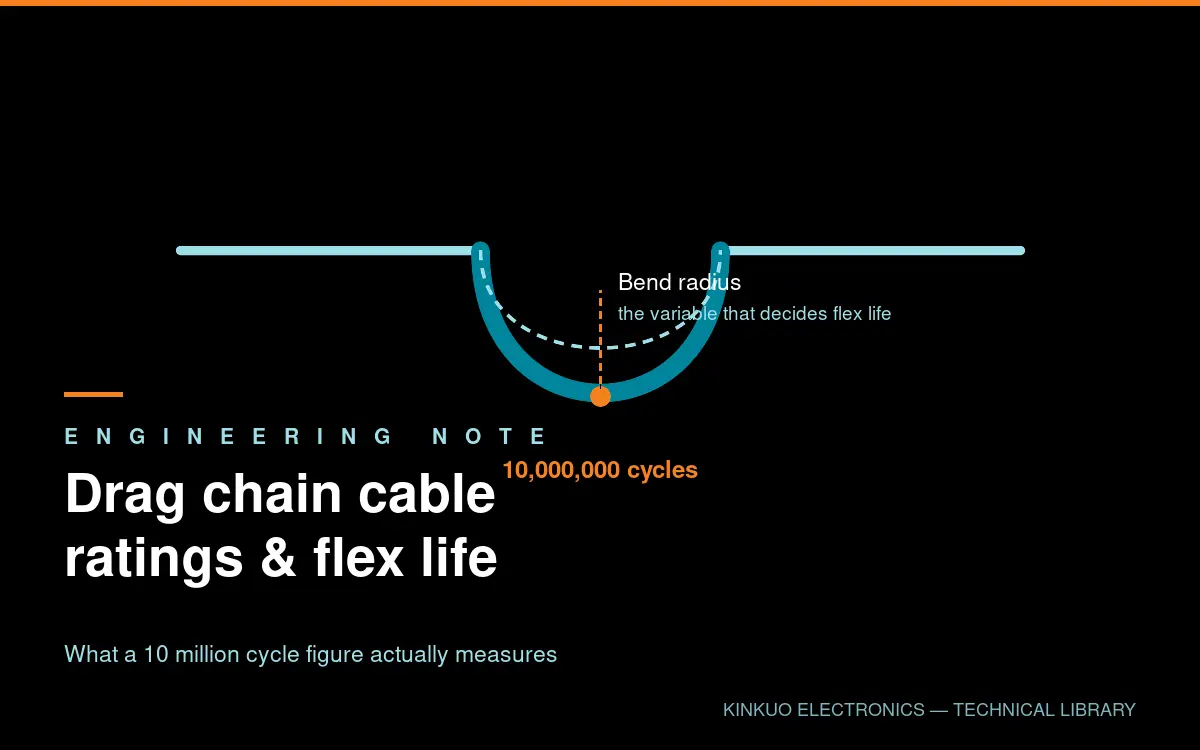
Failure in a drag chain cable is almost never electrical. It is mechanical: conductors work-harden and fracture because the cable was designed for a static installation and is being used in a cable carrier.
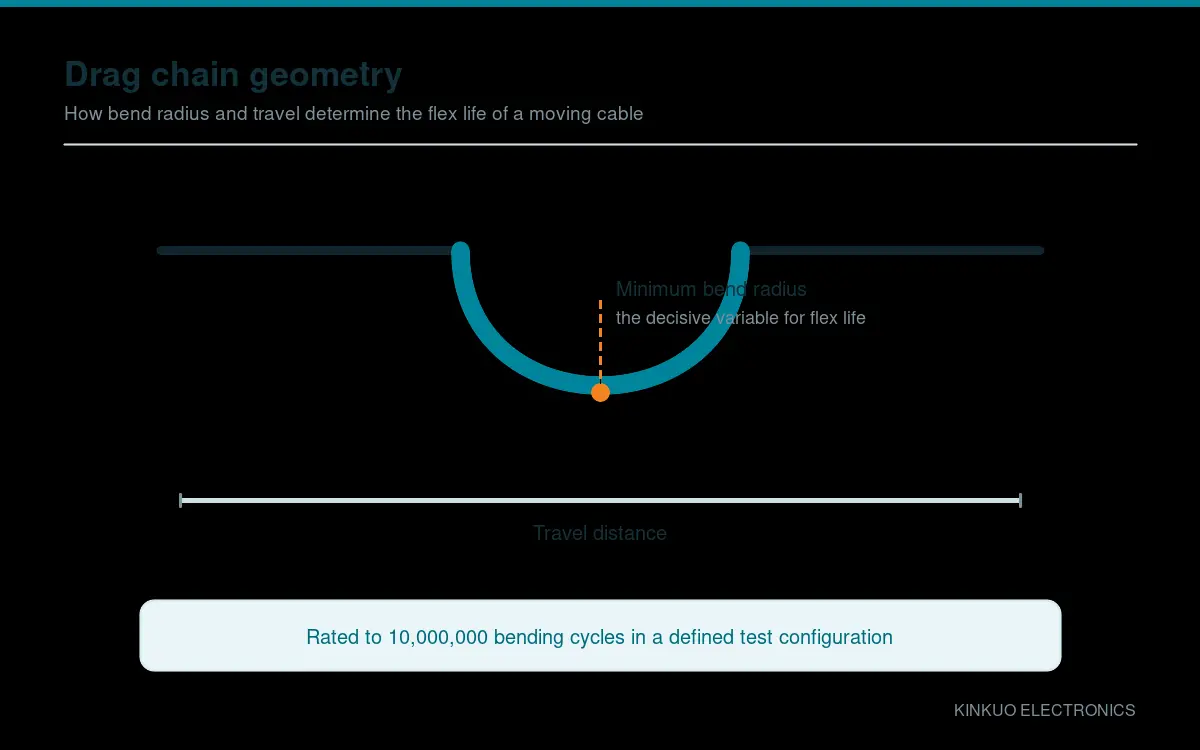
The failure typically appears at the point of minimum bend radius rather than at the connector, and it presents as an intermittent fault long before it becomes an open circuit — which is why drag chain problems are so often misdiagnosed as drive or controller faults.
Drag chain cable design: what makes a cable suitable
Four construction details separate a drag chain cable from a general-purpose one.
Conductor stranding. A stranded conductor flexes by distributing strain across many fine strands. The finer the stranding, the more cycles it survives. A conductor made of a few thick strands will fail far sooner than one made of many thin strands of the same total cross-section.
Core construction. Conductors must be laid up with fillers that maintain the internal geometry through repeated bending. Without fillers, the cores migrate, the cable develops a flat spot at the bend, and localised stress accelerates failure.
Shield design. A braided shield tolerates flexing; a wrapped foil shield does not, because it cracks. Drag chain assemblies use braided shields with a drain arrangement that survives movement.
Jacket compound. The jacket must stay flexible across the operating temperature range and resist the oils and coolants present in the environment, without hardening. PUR and certain TPE compounds are used for this reason; a PVC jacket that stiffens with age turns a flexible cable into a rigid one.
What a bending cycle rating means
A rating of 10 million bending cycles is a qualified figure, not a marketing claim. It means a sample of that construction was tested in a defined configuration — specified bend radius, specified travel distance, specified speed and acceleration — and survived that many cycles without failure.
Two qualifications matter when you compare ratings from different suppliers:
- The bend radius used. A cable tested at a generous multiple of its diameter will always outperform one tested at a tight radius. Ratings are only comparable when the test conditions are comparable.
- The failure criterion. Some suppliers count cycles until an electrical failure; others stop at the first sign of jacket damage. The former is the more meaningful figure for reliability purposes.
This is why we state the test conditions alongside the rating. A number without its test configuration is not useful engineering information.
Bend radius: the decisive variable
Bend radius has more influence on flex life than any other single factor, and the relationship is non-linear. Reducing the radius well below the specification can cut expected life by an order of magnitude rather than by a proportionate amount.
Measure the actual radius your installation produces, not the radius you intended. Cable carriers that are undersized for the bundle, or cable that is forced around a tight corner at a cabinet entry, are the two most common causes of premature failure.
Installation practice that extends life
- Run cables in the carrier without twisting — one continuous bend plane only
- Separate cables of different diameters so they do not beat against each other
- Secure cable at both ends of the travel, but allow the loop to move freely
- Never pull a cable through a carrier by its connector
- Check the strain relief at the cabinet entry; this is where most damage begins
Troubleshooting an existing failure
If a cable has failed, cut it open at the failure point. If the conductor fracture shows as a clean break with a granular surface, the cause is fatigue from repeated bending. If the insulation is discoloured or brittle, temperature or chemical attack is involved. If the shield shows cracks, the shield construction was wrong for the application.
The diagnosis determines the fix: a different construction, a larger bend radius, a different jacket compound, or a routing change.
Specifying a high-flex cable
To recommend a construction we need the bend radius, the travel distance, the cycle rate, the number and type of signals, the environment and the required service life. With those, we will propose a construction and state the qualified flex life.
Our high-flex assemblies are rated to 10 million bending cycles. Read more about our custom cable assembly service, browse high-flex servo motor cables, or describe your application and we will recommend a construction.
Standards and further reading
Primary reference material for this topic is published by IEC. Where a customer programme requires conformance to a specific standard, tell us at the enquiry stage and we will confirm what documentation we can supply.
Leave a Reply