
The connector industry has seen demand shifts before, but the current one is different: it is happening faster, and it is driven by thermal and density limits rather than a protocol transition. High-speed connectors sit at the centre of it.
Why AI workloads stress high-speed connectors
Training and inference clusters move enormous volumes of data between accelerators, and the fabric that carries it is built from cabled links rather than backplane traces. A single rack can contain hundreds of high-speed connections, each running at 100G or 400G, in a space that was previously occupied by far fewer ports.
Three consequences follow directly.
Port density rises. More bandwidth in the same chassis height means more connectors per board, which means smaller pitches and tighter tolerances. Connector families that put two ports in the board footprint of one have become standard on fixed-form switches.
Thermal headroom becomes the constraint. Higher lane rates dissipate more power in the optical module, and the module’s heat has to go somewhere. This is one reason OSFP has gained ground over QSFP-DD in high-power applications: it was designed with a larger thermal path, at the cost of backwards compatibility.
Signal integrity margins shrink. At 112G and 224G per lane, impedance discontinuities that were tolerable at 25G become bit errors. Connector construction, cage design and cable assembly quality all move from “important” to “deterministic”.
Where the demand is concentrated
The connector families seeing the strongest pull are those sitting on the boundary between the switch ASIC and the outside world, and between the host board and the accelerator.
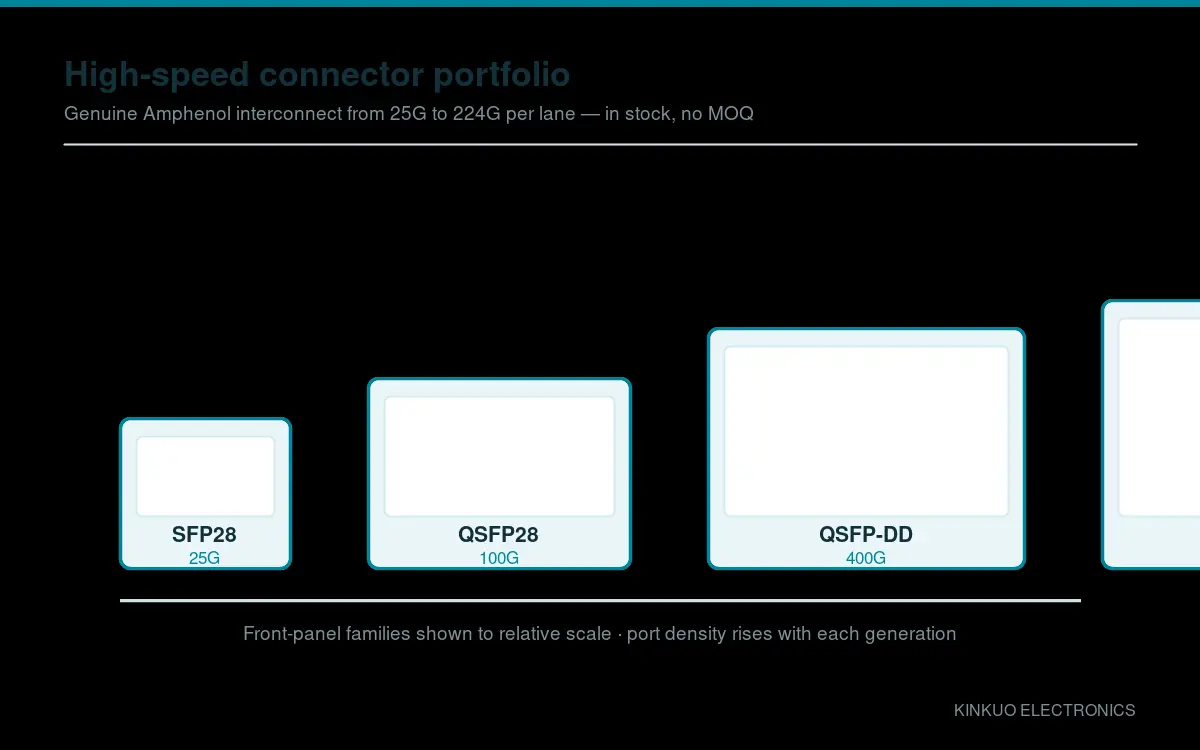
On the front panel this means SFP28 at 25G, QSFP28 at 100G, QSFP56 and QSFP-DD at 200G and 400G, and OSFP and OSFP-XD from 400G up to 1.6T. Inside the chassis it means MCIO, SlimSAS and Oculink for PCIe and NVMe links, where the requirements are lower loss over shorter distances but at very high density.
What this means for buyers
Two practical consequences are worth noting.
Availability is a design input, not an afterthought. When a platform is designed around a specific connector, a supply gap becomes a production stoppage. Working with a distributor that holds genuine stock — rather than one that orders against demand — is a meaningful risk reduction, particularly for validation builds and field replacements.
Traceability matters more than it used to. At 224G per lane, a counterfeit or sub-spec part does not fail visibly; it degrades link margin in ways that are difficult to diagnose. Full documentation and an authorised supply chain are not paperwork requirements, they are engineering requirements.
The industrial crossover
Something interesting is happening at the boundary. Machine-vision cameras now deliver 10 Gbit/s over X-coded M12. Industrial Ethernet runs Cat.6A over the same connectors that were designed for 100 Mbit/s. The techniques developed for data-centre interconnect — impedance control, pair shielding, controlled manufacturing tolerance — are migrating into factory-floor products.
For industrial customers, this is mostly good news: the components they need are the subject of far more development investment than they were a decade ago.
How KINKUO supports these programmes
As an authorised Amphenol distributor we supply genuine high-speed interconnect across the SFP, QSFP, QSFP-DD, OSFP and OSFP-XD, CFP2/CFP4, CDFP, MCIO, SlimSAS, MiniSAS HD, Gen-Z, Oculink and Power Card Edge families — in stock, with no minimum order quantity and at prices below official list.
Browse the Amphenol connector range, view our Oculink and MiniSAS cable assemblies, or read our guide to choosing between QSFP-DD and OSFP.
Standards and further reading
Primary reference material for this topic is published by INCITS T10, EMVA standards, PROFIBUS & PROFINET International. Where a customer programme requires conformance to a specific standard, tell us at the enquiry stage and we will confirm what documentation we can supply.
Leave a Reply