
A custom cable assembly solves the problems a catalogue cable cannot. KINKUO engineers them to drawing, with the tooling, testing and documentation to match.
Compliance documentation covering RoHS and REACH is available for every part number we supply, and high-speed interconnect is sourced through Amphenol‘s authorised channel.
KINKUO builds custom cable assemblies to drawing, with the engineering support to turn an application description into a manufacturable specification.
What a custom cable assembly can solve
- Signal and control cables — double-shielded SCSI, VHDCI, SDR, D-SUB, LFH and USB assemblies
- High-flex drag-chain cables — qualified to 10 million bending cycles for continuous motion
- Servo and encoder cables — cross-referenced to Siemens, Panasonic, Mitsubishi and FANUC platforms
- Camera and vision harnesses — Camera Link, GigE Vision, RJ45-to-M12 in A, D and X coding
- Industrial network cables — Cat.5e and Cat.6A constructions for machine-level Ethernet
- Oil-resistant wiring harnesses — for metalworking and coolant-exposed environments
- High-speed assemblies — Oculink, MiniSAS HD, SlimSAS, MCIO and Gen-Z for compute and storage
- Breakout and fan-out assemblies — one connector to many, or many to one, with controlled pair assignment
How the engineering process works
1. Requirements capture. Send a drawing, a part number, a photograph of a failed component, or simply describe the application. Useful detail includes the signal type and frequency, the motion profile, the environment, the required mating cycles, the annual volume and any standards the part must satisfy.
2. Specification and quotation. We respond with a proposed construction — connector type, cable stock, shielding strategy, jacket material, termination method and overmoulding — along with pricing, lead time and any tooling implications. Quotations are itemised with no hidden tooling fees.
3. Sample and validation. Sample assemblies are produced for your validation. Everything is tested to the specification with a test report supplied, so approval is based on measured performance rather than appearance.
4. Production. Approved designs move to production on calibrated equipment with in-process inspection at every station. Established programme tooling is amortised across the order rather than charged up front.
5. Delivery and documentation. Finished assemblies ship with test reports and any material declarations your quality system requires. Trade terms include FOB, EXW, CIF and DDP.
Flex life and mechanical design
Cable failure in moving applications is almost always mechanical. Conductors work-harden and fracture when a cable designed for static installation is used in a carrier, and the fracture typically appears at the point where the bend radius is smallest rather than at the connector.
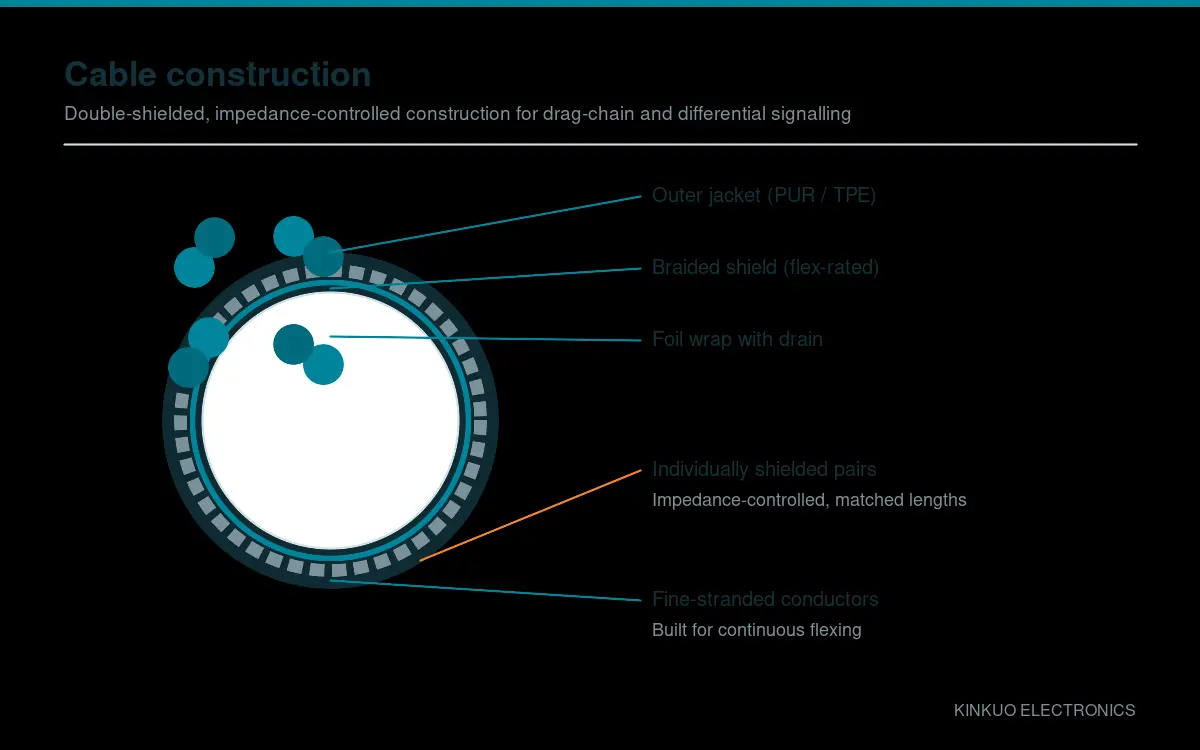
Drag-chain assemblies are therefore built differently: finely stranded conductors, fillers that maintain the internal geometry through repeated bending, a jacket formulated for continuous flex, and a bend-radius specification that we will state explicitly. Our high-flex constructions are qualified to 10 million bending cycles.
Shielding and signal integrity
Shielding only works if it is terminated. A foil wrap that stops at the connector body, or a drain wire that runs alongside the pairs instead of bonding to the shell, leaves the high-speed channels exposed to whatever the drive cabinet is radiating.
Our shielded assemblies terminate the shield to the connector shell and, where the design requires it, use individually shielded pairs with matched lengths. High-speed constructions are impedance-controlled and verified with TDR analysis before dispatch.
Volume, MOQ and tooling
Orders start from low quantities because validation should not require a production commitment. Prototype and small-batch runs are quoted on the same basis as volume orders, so there is no commercial cliff between proving a design and scaling it.
Where custom tooling is required — an unusual overmould profile, for example — the cost is amortised across the order rather than invoiced separately, and the tooling is retained for future runs so a repeat order does not repeat the cost.
Starting a project
The most useful thing you can send is the problem: what the cable has to do, where it has to fit, and what has failed before. Drawings help, but they are not a prerequisite — we engineer designs from application descriptions regularly.
Send your requirement to King@KinKuo.com or use the contact form. Most technical enquiries receive a response within two hours during business days, and samples for stock-based constructions are dispatched within 24 hours.
You can also browse the standard range to see the connector platforms and cable constructions we build from, or read about our quality control process and test equipment.