
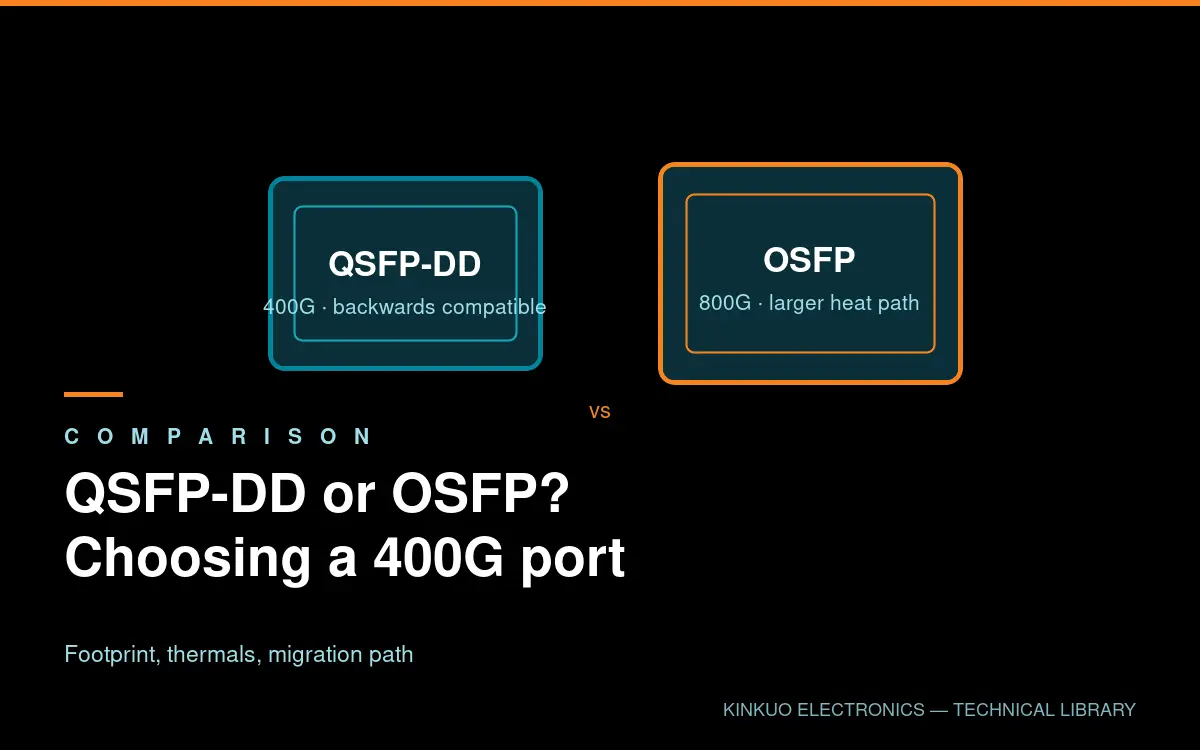
QSFP-DD vs OSFP is a question about constraints, not bandwidth. Both deliver 400 Gbit/s and both are multi-source standards, so the choice comes down to which limit binds your platform.
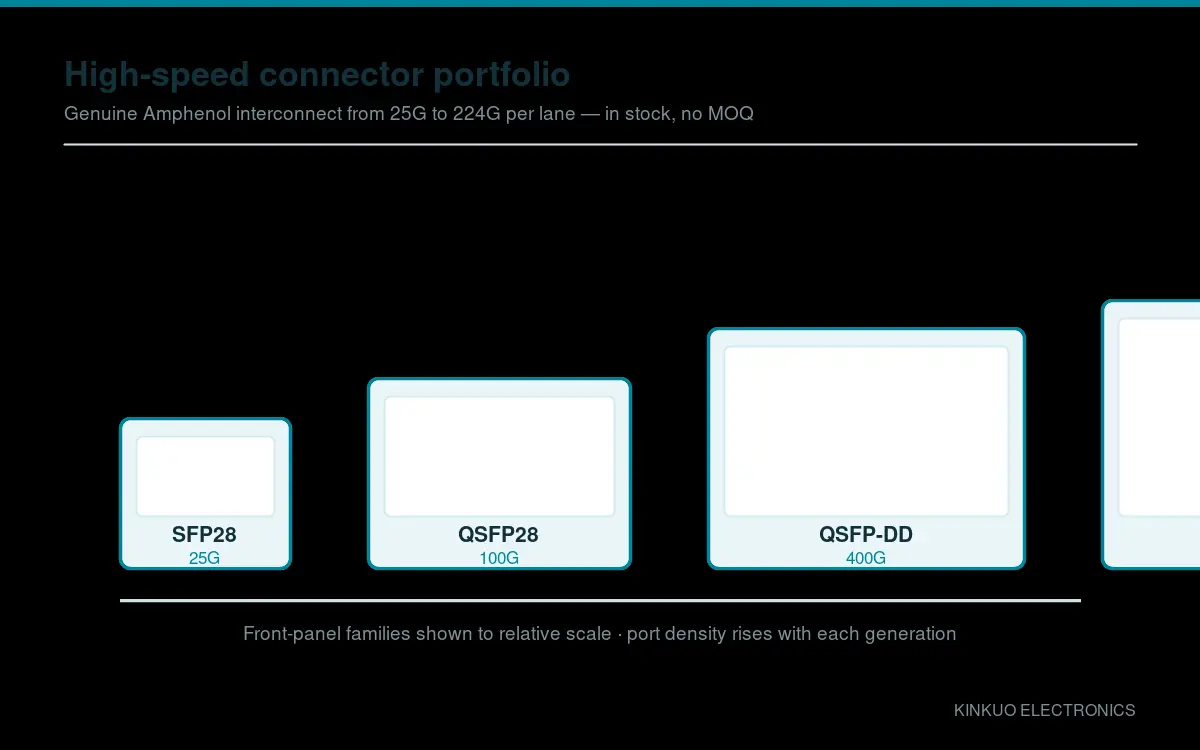
QSFP-DD vs OSFP: the mechanical difference
QSFP-DD (Double Density) doubles the number of contact rows in the existing QSFP footprint. The cage width, height and board footprint remain compatible with earlier QSFP modules, which means a QSFP-DD port accepts a QSFP, QSFP28 or QSFP56 module.
OSFP (Octal Small Form-factor Pluggable) is a new mechanical design built specifically for higher lane counts and higher module power. Its cage is slightly larger and its module is physically different, so it does not accept QSFP modules and cannot be plugged into a QSFP-DD cage.
Thermals: the deciding factor
The reason OSFP exists is heat. A 400G module dissipates materially more power than a 100G module, and higher per-lane rates push that further. OSFP’s larger form factor provides a bigger thermal path between the module and the cage heat sink, and the standard includes an integrated heat sink on the module itself.
For high-power 400G and 800G optics — particularly coherent modules in DCI roles — the thermal headroom of OSFP is often the difference between a stable link and a module that thermally throttles in a hot aisle.
QSFP-DD can be cooled adequately in most 400G access and aggregation applications, provided the platform’s airflow design is sound. The trade-off is real but not universal.
Backwards compatibility
If you have existing QSFP infrastructure and want to migrate gradually, QSFP-DD’s compatibility is a significant operational advantage. You can deploy a QSFP-DD switch, populate it with 100G QSFP28 modules today, and upgrade port by port as the fabric grows.
OSFP commits you to OSFP modules at every populated port. In a greenfield 800G deployment that is irrelevant. In an existing network with a substantial base of installed optics, it is a cost that has to be weighed deliberately.
Upgrade path
Both families have defined upgrade routes. QSFP-DD extends to QSFP-DD800 and beyond through the same cage; OSFP extends to OSFP-XD, which supports 1.6T aggregate. At 224G per lane, both are viable, and the choice again comes down to thermal management and platform design.
A practical decision framework
Choose QSFP-DD when:
- You need backwards compatibility with existing QSFP or QSFP28 optics
- You are upgrading an existing platform incrementally
- Module power is moderate and platform airflow is well characterised
- Board space is the primary constraint
Choose OSFP when:
- You are building a greenfield 800G or 1.6T platform
- High-power optical modules are involved
- Thermal headroom is the binding constraint
- You want the broadest upgrade path to 224G per lane
QSFP-DD vs OSFP: what does not change
Whichever family you select, the signal-integrity fundamentals are the same. Impedance has to be controlled through the connector, the cage and the cable assembly. Shield termination has to be complete. And the parts have to be genuine — at these lane rates, a sub-spec component degrades link margin in ways that are expensive to diagnose in a live network.
Availability
KINKUO supplies genuine Amphenol QSFP-DD connectors, including stacked 2×1 configurations, alongside the full OSFP and OSFP-XD range up to 224G per lane. All held in stock with no minimum order quantity, which makes single-port replacement practical as well as volume deployment.
Browse the QSFP-DD range or the OSFP range, and contact our engineering team if you need signal-integrity data or thermal guidance for a specific platform.
Standards and further reading
Primary reference material for this topic is published by Amphenol. Where a customer programme requires conformance to a specific standard, tell us at the enquiry stage and we will confirm what documentation we can supply.
Leave a Reply