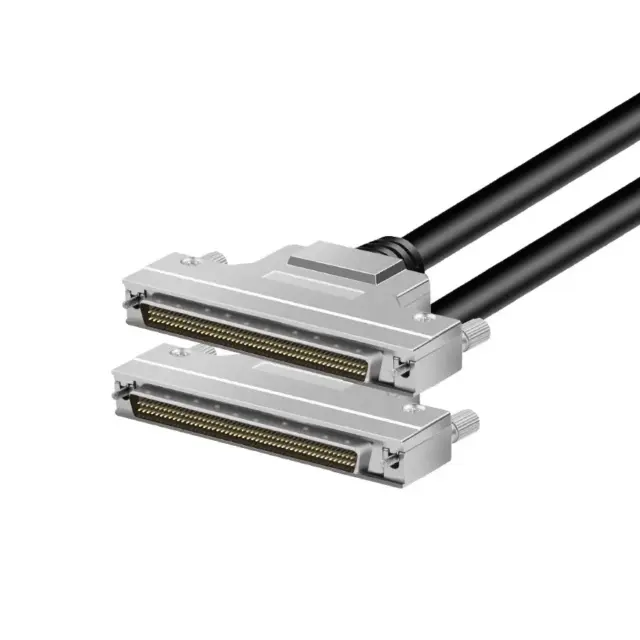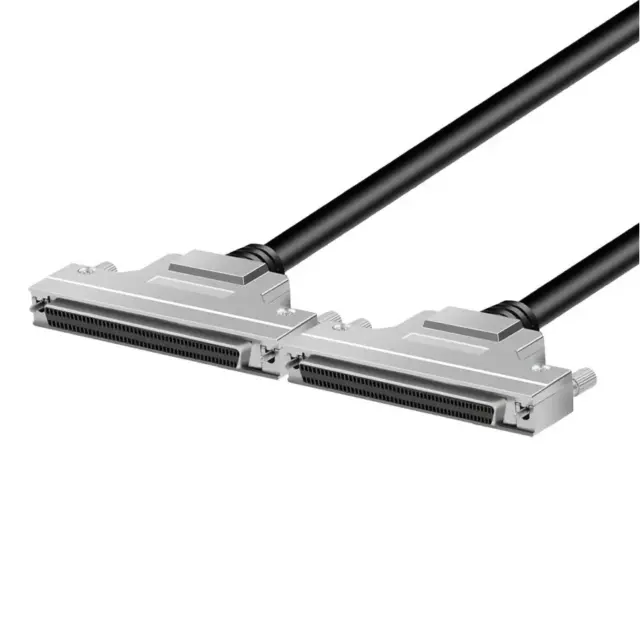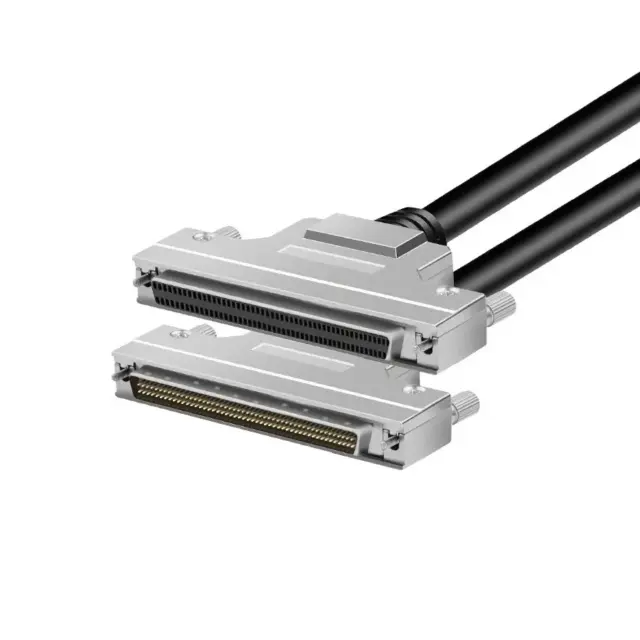
The VHDCI 100Pin Male Cable Connector is part of the VHDCI Series range and is supplied in stock from our factory in Dongguan. Very High Density Cable Interconnect packs 100 contacts into a shell barely wider than a 68-pin part, which is why it survives in multi-channel data acquisition and legacy RAID arrays. This male cable version takes standard solder termination.
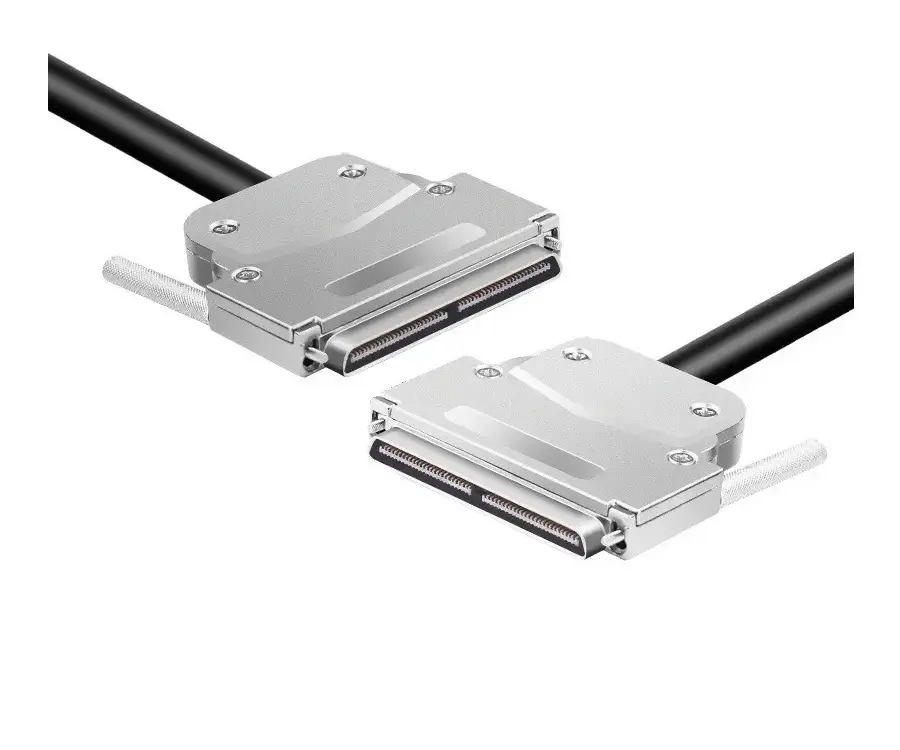
Contact layout of this VHDCI 100Pin Male Cable Connector
Every unit is inspected before dispatch and ships with a test report, so incoming inspection becomes a document check rather than a re-test. Material compliance is documented against RoHS and REACH.
Key features
- 100 contacts in a compact VHDCI shell
- Solder-cup termination with generous wire clearance
- Latching screw posts for secure panel retention
- Gold contacts for low insertion loss
Technical specifications
| Positions | 100 |
|---|---|
| Gender | Male |
| Termination | Solder cup |
| Contact plating | Gold over nickel |
| Retention | Screw posts |
| Insulator | High-temperature thermoplastic |
| Part number | B04-10031134-01 |
| Minimum order | 1 pc |
| Compliance | RoHS and REACH compliant materials |
Typical applications
Multi-channel DAQ, legacy RAID arrays, industrial imaging and test racks.
Ordering information
- Minimum order quantity: 1 pc
- Availability: In stock
- Lead time: Ships within 24 hours
- Sample service: samples for engineering validation are dispatched within 24 hours on stock items.
- Trade terms: FOB, EXW, CIF and DDP are all supported.
Custom configurations are available on request — alternative lengths, pin-outs, shielding arrangements and overmoulding can all be engineered to your drawing. Send the specification to King@KinKuo.com and our engineering team will confirm feasibility and pricing.
Quality assurance
KINKUO operates an ISO 9001:2015 certified quality system. Production runs through in-process inspection at every station, covering continuity, dielectric strength, insulation resistance and visual criteria. Finished vhdci connectors are verified against the drawing before packing, and a test report accompanies every shipment.
Working with high-density contacts
VHDCI packs 68 or 100 contacts into a shell barely wider than a standard 68-pin part. The density is the point, but it changes how the connector has to be handled — both during assembly and when a cable is being mated in a rack.
- Align the connector square before applying insertion force. Angled insertion bends contacts that are difficult to inspect and expensive to replace.
- Use the thumbscrew or screw-post retention rather than relying on friction. High contact counts produce high insertion and withdrawal forces.
- Inspect for bent contacts with magnification after any forced mating event.
- Keep the mating face clean; fine debris bridges adjacent contacts at this pitch far more readily than at 1.27 mm.
- Plan the wiring breakout before assembly — 100 conductors need a controlled fan-out to avoid strain at the termination.
Common questions
Is VHDCI still a sensible choice for new designs?
For rack equipment where rear-panel space is constrained, yes. It offers the highest channel count per unit width, and the connectors and cable assemblies remain readily available.
How many mating cycles can I expect?
Specified cycle counts vary by variant, but VHDCI is generally rated in the hundreds of cycles. If a connector is mated daily, plan for periodic replacement.
Understanding the specification
The figures in the table above are not independent of one another. Read together they describe how this VHDCI 100Pin Male Cable Connector will behave in service, and where the practical limits sit once it is installed in equipment rather than tested on a bench.
- Positions (100): Position count sets how many independent circuits the interface carries. Higher counts raise contact density, which makes correct insertion alignment and contact retention more critical than on a low-count connector.
- Gender (Male): Gender is determined by the mating half already fixed in your design. Male contacts are more exposed and therefore need greater care during handling and storage.
- Termination (Solder cup): Termination method affects repeatability more than it affects peak performance. Crimp joints are controlled by tooling; solder joints are controlled by the operator.
- Contact plating (Gold over nickel): Plating governs contact resistance stability over time. Gold over a nickel barrier is the standard choice where low, repeatable resistance matters across many mating cycles.
- Retention (Screw posts):
- Insulator (High-temperature thermoplastic):
Selecting a VHDCI connector
The decision is usually driven by panel space. VHDCI puts 68 or 100 contacts into a shell barely wider than a standard 68-pin part, which is why it survives in rack equipment where rear-panel real estate is scarce and channel counts keep rising.
Confirm the pin count against the interface and check whether the mating hardware uses screw posts or thumbscrews — the two are not interchangeable in service, and a rack-mounted connector without positive retention will work loose as cables are moved during maintenance.
Contact pitch is the parameter to respect during assembly. At this density, a connector inserted at an angle bends contacts that are difficult to inspect and expensive to replace. Alignment before applying force is the single most important handling rule.
Where the design is new rather than a replacement, consider whether the channel count genuinely requires VHDCI. If it does not, a 1.27 mm pitch family is easier to assemble, easier to service and less sensitive to debris at the mating face.
Packaging, delivery and documentation
This item is in stock with a minimum order quantity of 1 pc and a stated lead time of ships within 24 hours. Orders ship on FOB, EXW, CIF or DDP terms as agreed at order confirmation, with real-time tracking provided once the shipment is booked.
Packaging is specified to survive international freight rather than to minimise volume. Connectors are supplied in anti-static packaging with pin protection where the contact geometry requires it; cable assemblies are coiled to a radius that respects the flex specification and secured so the assembly cannot move in transit. Both ends are labelled on multi-channel assemblies so a field replacement cannot be mis-wired.
Every shipment is accompanied by a test report covering continuity, dielectric strength, insulation resistance and any application-specific measurement performed. Where your quality system requires material declarations, batch traceability or joint sampling and sealing, confirm the requirement at the enquiry stage and we will build it into the order rather than adding it after production.
Further questions
Can I get a sample before committing to a production order?
Yes. Samples for engineering validation are dispatched within 24 hours for stocked items, and within the quoted production lead time for made-to-order assemblies. Every sample ships with its test report so that your validation is based on measured performance rather than on appearance.
What happens if the part does not fit the application?
Send us the mating half, a photograph or the equipment model and we will identify why. In most cases the answer is a different keying or coupling variant of the same family rather than a completely different product, and we would rather resolve it before you place a volume order than after.
Do you hold stock for repeat orders?
Stocked lines are held with safety quantity, and made-to-order tooling is retained so a repeat order does not repeat the tooling cost. For scheduled programmes we can agree a call-off arrangement that keeps material allocated against your forecast.
How this connector is manufactured and tested
Production starts with incoming material control. Housings, contacts, shells and plating are checked against specification on receipt, covering dimensional accuracy, plating thickness, insulator material and hardness, with material certificates retained against the batch.
Assembly then runs through inspection at every station rather than a single check at the end. Crimp height and pull force are verified where crimp termination is used; contact insertion and retention are confirmed; and the pin-out and keying are checked against the drawing before the part moves on. Because the process is controlled station by station, a drift is corrected inside the batch rather than discovered after several hundred assemblies are complete.
Electrical testing covers continuity and short checking, dielectric strength at the rated voltage, and insulation resistance at 500 V DC. Insertion and withdrawal force is measured against specification on sampled units, and where the application involves repeated mating — test fixtures in particular — we test to the customer's duty cycle rather than to a generic figure. A test report accompanies every shipment.
Where a part carries a custom pin-out or a non-standard shell configuration, a first-article inspection is performed and retained so that subsequent batches can be compared against a documented reference rather than against a drawing alone.
Warranty, returns and technical support
Connectors are warranted against defects in materials and workmanship that appear under normal use for a period of 30 days from delivery, or for the period stated on the order confirmation if different. Where a verified defect is found, we will at our option repair, replace or refund the affected goods. The warranty does not cover damage arising from incorrect insertion force, contamination at the mating face, use outside the published ratings, or unauthorised modification.
Returns require a return authorisation before shipment, and goods should be retained in their original condition pending inspection. Stocked items returned unused in original packaging may be accepted within 30 days subject to a restocking assessment; assemblies built to a customer drawing are not returnable unless defective.
Technical support is provided by the same engineers who handle the specification, not by a separate call centre. If a VHDCI 100Pin Male Cable Connector behaves unexpectedly in service, send us the installation detail — cable length, routing, environment and the symptom pattern — and we will work through the likely causes with you. Enquiries are answered within two hours during business days, and on-site technical support can be arranged for programmes where that is more practical than remote diagnosis.
Ordering checklist
To quote accurately and avoid a second iteration, we need the part number or the original manufacturer reference, the quantity required for validation and for production, the required delivery date, and the destination country so that the correct Incoterm can be applied. Where the item is a replacement for an obsolete part, a photograph of the existing connector and the equipment model will usually let us confirm the equivalent without a sample.
If your quality system requires material declarations, batch traceability, joint sampling and sealing, or a first-article inspection report, state that at the enquiry stage. These can all be accommodated, but retrofitting them into a production schedule costs more time than building them in from the start.
Technical documents
The original drawings and datasheets for this part are available to download. They are the documents issued by the manufacturer and are the reference to quote against when confirming a specification or a cross-reference.
If you need a document that is not listed here — a material declaration, a test report for a specific batch, or a dimensioned drawing in a different format — send the request to King@KinKuo.com and we will confirm availability.
Why source this part from KINKUO
We manufacture rather than resell, which means the part you receive is built on our own calibrated equipment by the same team that engineers it. That removes the margin stacking of a trading chain and keeps lead times predictable. Established in 2010, we supply vhdci connectors to customers across South China, East China, Japan, Europe and North America.
Related products
Browse the full VHDCI Connectors range, or contact our engineering team for a part-number cross reference.