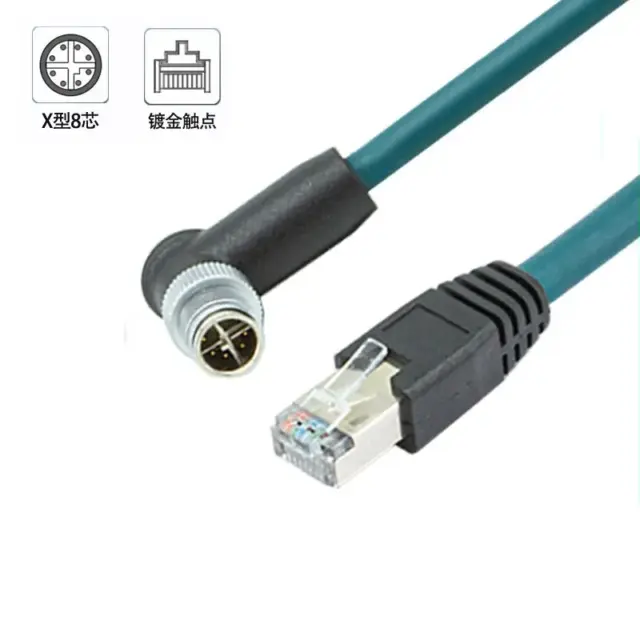
The RJ45 Cat.5e Industrial Camera Link Cable is part of the GigE Vision Cable range and is supplied in stock from our factory in Dongguan. Where a camera runs GigE at 1 Gbit/s, Cat.5e is still the sensible engineering choice. This assembly uses a high-flex jacket and shielded pairs so it performs in the same drag chains as the higher-spec Cat.6A version.
Shielding inside the RJ45 Cat.5e Industrial Camera Link Cable
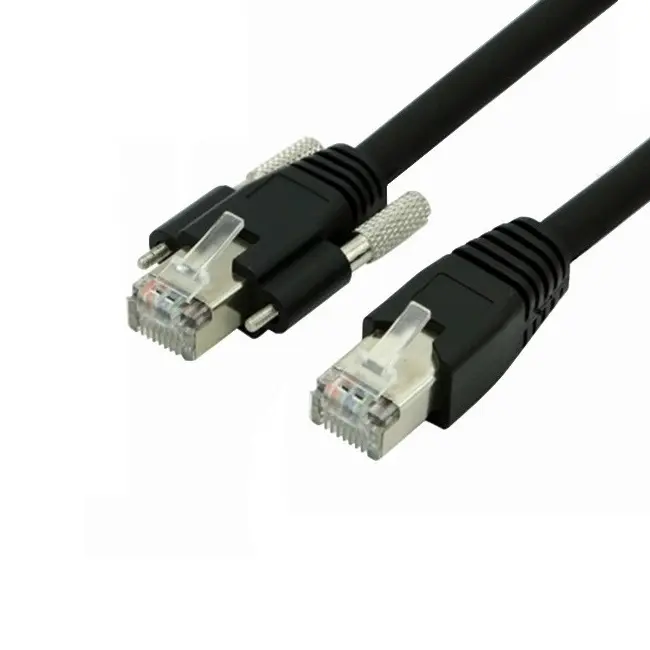
Every unit is inspected before dispatch and ships with a test report, so incoming inspection becomes a document check rather than a re-test. Material compliance is documented against RoHS and REACH.
Key features
- Shielded pairs for reliable 1 Gbit/s GigE
- High-flex jacket for continuous motion
- RJ45 with latch and strain relief
- Available in straight and right-angle forms
Technical specifications
| Configuration | RJ45 to RJ45, Cat.5e |
|---|---|
| Performance | 1 Gbit/s |
| Length | 1, 3, 5, 10 m or custom |
| Jacket | PUR, oil resistant |
| Shielding | SF/UTP |
| Compliance | RoHS, REACH |
| Part number | A15-080M1210-XXM |
| Minimum order | 10 pcs |
| Compliance | RoHS and REACH compliant materials |
Typical applications
GigE Vision cameras, industrial Ethernet links and inspection lines.
Ordering information
- Minimum order quantity: 10 pcs
- Availability: In stock
- Lead time: Ships within 48 hours
- Sample service: samples for engineering validation are dispatched within 24 hours on stock items.
- Trade terms: FOB, EXW, CIF and DDP are all supported.
Custom configurations are available on request — alternative lengths, pin-outs, shielding arrangements and overmoulding can all be engineered to your drawing. Send the specification to King@KinKuo.com and our engineering team will confirm feasibility and pricing.
Quality assurance
KINKUO operates an ISO 9001:2015 certified quality system. Production runs through in-process inspection at every station, covering continuity, dielectric strength, insulation resistance and visual criteria. Finished camera link cables are verified against the drawing before packing, and a test report accompanies every shipment.
Length limits, power and jitter
Camera cables sit at the intersection of mechanical robustness and signal integrity. A cable that works on a bench can still drop frames in a cell where drives, welders or servos are running nearby.
- Confirm the data rate before choosing a cable: Cat.5e for 1 Gbit/s GigE, Cat.6A where 10 Gbit/s is required.
- Check the power budget if the camera is powered over the link. Voltage drop over a long run is a common cause of intermittent camera resets.
- Keep camera cables away from drive cabling and cross other cables at right angles where they must intersect.
- Use drag-chain rated cable on any moving axis, and state the bend radius.
- Respect the interface length limit. Beyond it, use a repeater or fibre rather than a longer copper cable.
Common questions
Why does my camera drop frames intermittently?
In most cases the shield is not terminated to the connector shell, or the pairs are not impedance-controlled through the termination. Check shield continuity end to end before replacing the camera.
Can I run GigE Vision over 100 metres?
The standard allows it on copper, but in an electrically noisy cell the practical limit is shorter, especially with power over Ethernet. Consider a fibre link for long runs.
Understanding the specification
The figures in the table above are not independent of one another. Read together they describe how this RJ45 will behave in service, and where the practical limits sit once it is installed in equipment rather than tested on a bench.
- Configuration (RJ45 to RJ45, Cat.5e):
- Performance (1 Gbit/s): Performance figures are stated for a defined channel. Real-world results depend on the cable assembly and the termination quality as much as on the connector itself.
- Length (1, 3, 5, 10 m or custom): Length should be the shortest that meets the routing requirement. Extra cable adds loss, capacitance and cost without adding capability.
- Jacket (PUR, oil resistant): The jacket compound determines chemical resistance and how the cable behaves at temperature extremes. A jacket that hardens with age turns a flexible cable into a rigid one.
- Shielding (SF/UTP): Shielding only works when it is terminated. A shield that stops short of the connector shell leaves the signal path exposed to whatever the cabinet is radiating.
- Compliance (RoHS, REACH): Compliance covers the material declarations your quality system will ask for. The declarations are available for every part number we supply.
Selecting a camera cable
Camera cables sit at the intersection of mechanical robustness and signal integrity. A cable that performs on a bench can still drop frames in a cell where drives, welders or servos are running nearby.
Confirm the data rate before choosing a construction. Cat.5e is sufficient for 1 Gbit/s GigE, while 10 Gbit/s requires Cat.6A throughout — not only at the connector, but across the full cable and both terminations.
Check the power budget if the camera is powered over the link. Voltage drop over a long run is a common cause of intermittent camera resets that are initially blamed on the camera firmware.
For moving axes, specify drag-chain rated cable and state the bend radius. Then plan the routing: keep camera cables away from drive cabling, and cross other cables at right angles where they must intersect. Respect the interface length limit — beyond it, a repeater or fibre link is the correct answer.
Packaging, delivery and documentation
This item is in stock with a minimum order quantity of 10 pcs and a stated lead time of ships within 48 hours. Orders ship on FOB, EXW, CIF or DDP terms as agreed at order confirmation, with real-time tracking provided once the shipment is booked.
Packaging is specified to survive international freight rather than to minimise volume. Connectors are supplied in anti-static packaging with pin protection where the contact geometry requires it; cable assemblies are coiled to a radius that respects the flex specification and secured so the assembly cannot move in transit. Both ends are labelled on multi-channel assemblies so a field replacement cannot be mis-wired.
Every shipment is accompanied by a test report covering continuity, dielectric strength, insulation resistance and any application-specific measurement performed. Where your quality system requires material declarations, batch traceability or joint sampling and sealing, confirm the requirement at the enquiry stage and we will build it into the order rather than adding it after production.
Further questions
Can I get a sample before committing to a production order?
Yes. Samples for engineering validation are dispatched within 24 hours for stocked items, and within the quoted production lead time for made-to-order assemblies. Every sample ships with its test report so that your validation is based on measured performance rather than on appearance.
What happens if the part does not fit the application?
Send us the mating half, a photograph or the equipment model and we will identify why. In most cases the answer is a different keying or coupling variant of the same family rather than a completely different product, and we would rather resolve it before you place a volume order than after.
Do you hold stock for repeat orders?
Stocked lines are held with safety quantity, and made-to-order tooling is retained so a repeat order does not repeat the tooling cost. For scheduled programmes we can agree a call-off arrangement that keeps material allocated against your forecast.
How this cable assembly is manufactured and tested
Cable stock is inspected on receipt for conductor stranding, shield coverage, jacket concentricity and print legibility, because these properties determine the electrical behaviour of the finished assembly far more than the connector does. Reel-level certificates are retained for traceability.
Assembly is carried out on calibrated equipment with the shield terminated to the connector shell around the full circumference. On assemblies with individually shielded pairs, each pair shield is terminated as well — this is the detail that separates a cable which holds a differential signal from one that works on a bench and drops frames in a cabinet. Pair lengths are matched where the assembly carries differential channels.
Testing covers continuity and short checking across every conductor, dielectric strength, and insulation resistance. High-speed and Camera Link assemblies are additionally verified with TDR impedance analysis, which confirms characteristic impedance along the length and locates any discontinuity introduced by the termination. Flex-rated constructions are qualified against the stated bend radius and travel distance rather than a generic figure.
Finished assemblies are coiled to a radius that respects the flex specification, labelled at both ends on multi-channel products, and packed so that the assembly cannot move in transit. The test report for the batch accompanies the shipment.
Warranty, returns and technical support
Cable assemblies are warranted against defects in materials and workmanship that appear under normal use for a period of 30 days from delivery, or for the period stated on the order confirmation if different. Where a verified defect is found, we will at our option repair, replace or refund the affected goods. The warranty does not cover failure arising from installation below the specified bend radius, use outside the published temperature or voltage ratings, or damage caused by pulling the assembly by its connector.
Returns require a return authorisation before shipment, and goods should be retained in their original condition pending inspection. Stocked items returned unused in original packaging may be accepted within 30 days subject to a restocking assessment; assemblies built to a customer drawing are not returnable unless defective.
Technical support is provided by the same engineers who handle the specification, not by a separate call centre. If a RJ45 behaves unexpectedly in service, send us the installation detail — cable length, routing, environment and the symptom pattern — and we will work through the likely causes with you. Enquiries are answered within two hours during business days, and on-site technical support can be arranged for programmes where that is more practical than remote diagnosis.
Ordering checklist
To quote accurately and avoid a second iteration, we need the part number or the original manufacturer reference, the quantity required for validation and for production, the required delivery date, and the destination country so that the correct Incoterm can be applied. Where the item is a replacement for an obsolete part, a photograph of the existing connector and the equipment model will usually let us confirm the equivalent without a sample.
If your quality system requires material declarations, batch traceability, joint sampling and sealing, or a first-article inspection report, state that at the enquiry stage. These can all be accommodated, but retrofitting them into a production schedule costs more time than building them in from the start.
Technical documents
The original drawings and datasheets for this part are available to download. They are the documents issued by the manufacturer and are the reference to quote against when confirming a specification or a cross-reference.
If you need a document that is not listed here — a material declaration, a test report for a specific batch, or a dimensioned drawing in a different format — send the request to King@KinKuo.com and we will confirm availability.
Why source this part from KINKUO
We manufacture rather than resell, which means the part you receive is built on our own calibrated equipment by the same team that engineers it. That removes the margin stacking of a trading chain and keeps lead times predictable. Established in 2010, we supply camera link cables to customers across South China, East China, Japan, Europe and North America.
Related products
Browse the full Camera Link Cables range, or contact our engineering team for a part-number cross reference.